
Last week, we saw that while salvation is God’s work from start to finish, we really do respond—and even that response is made possible by His drawing.
Missed it? Read Part 5 → Our Part in Believing
What Is Saving Faith?
This week, we’re picking up right where that left off. If faith is our response, the next question is: what is saving faith, and how does it begin?
Faith isn’t just nodding along to the facts; it’s trusting Jesus with everything.
Plenty of people say, “I believe in God,” but what they’re describing is closer to agreeing with a fact than trusting a Person—like believing Abraham Lincoln once lived. That kind of faith doesn’t save. It’s not enough to simply believe God exists.
James makes that point crystal clear:
“Even the demons believe—and tremble!” (James 2:19, NKJV)
The demons know God is real, and even respond with fear, but they don’t trust Him or follow Him. Their “belief” has no love, no surrender, no new life.
That’s James’s whole point in chapter 2: dead faith can talk, but it can’t walk. Real faith shows itself in action—not because works save, but because new life always bears fruit.
The Bible itself gives us raw pictures of this kind of trust. Think of the thief on the cross who cried, “Lord, remember me when You come into Your kingdom” (Luke 23:42). He had no chance to prove himself, no works to lean on—just trust in Jesus to save him. Or the woman with the issue of blood (Mark 5:25–34), whose desperate reach for His garment wasn’t a work that earned healing but an act of faith in who He is.
These aren’t stories of people earning salvation; they’re moments of surrender to the One who already offers it.
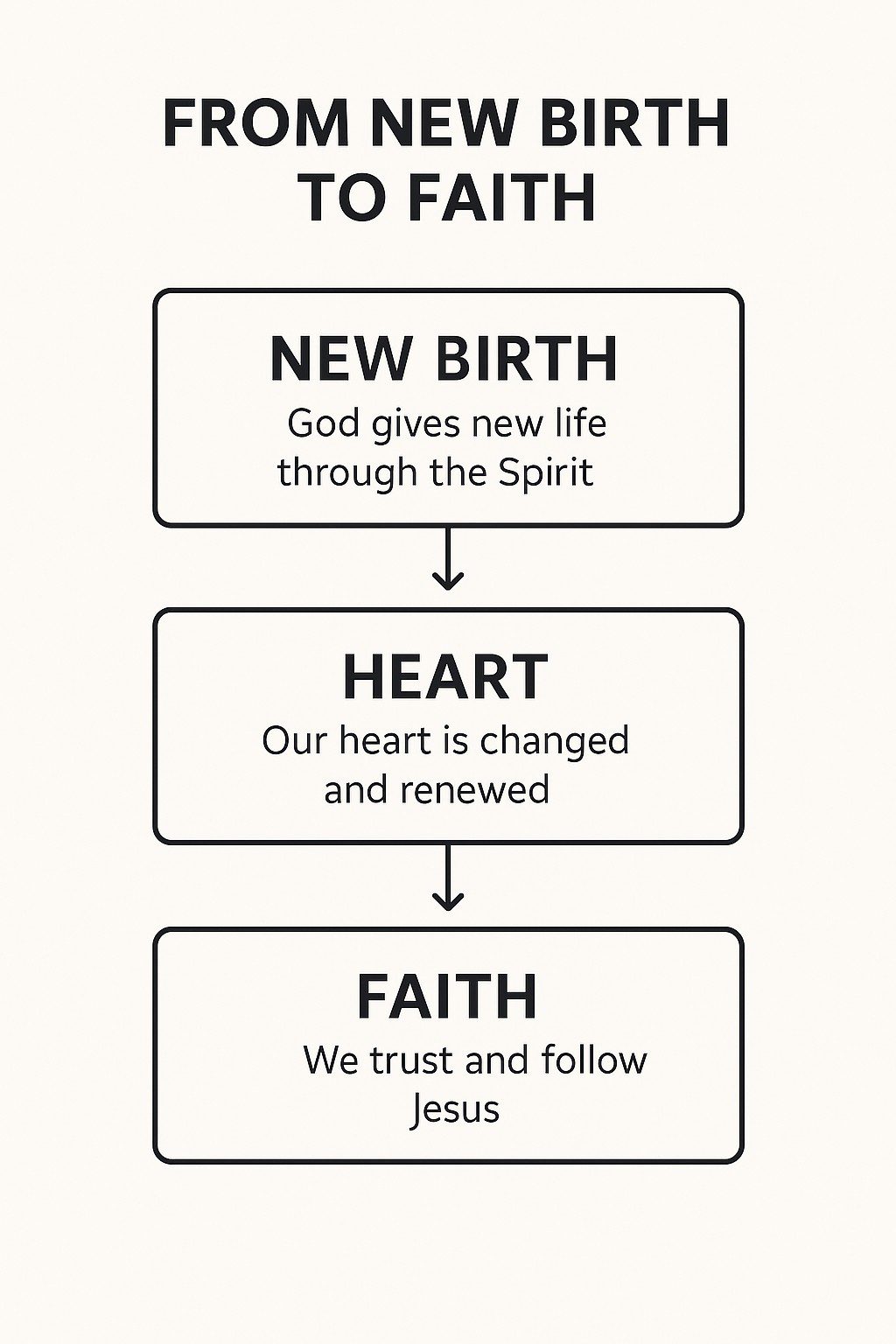
That’s why it has to begin somewhere deeper. It doesn’t start with us trying harder or convincing ourselves to believe. It begins with new life—a spiritual rebirth that only God can give.
Jesus made that plain to Nicodemus:
“Unless one is born again (gennaō), he cannot see the kingdom of God.”
(John 3:3, NKJV)
The Greek word gennaō means to be birthed—not just reformed or improved but made new from the inside out. It describes receiving life, not achieving it. Like a seed planted in soil, springing up by God’s power, salvation starts with His initiative, not ours.
John uses this word all throughout his writings to describe what it means to belong to God. In John 1:13, those who believe are described as being “born… of God.” In 1 John, the same term is used again and again — those “born of God” love their brothers and sisters (1 John 4:7), practice righteousness (1 John 2:29), and overcome the world (1 John 5:4). In other words, gennaō isn’t just about a moment of change — it’s the start of a whole new way of life.
And this wasn’t a new idea Jesus was dropping out of nowhere. God had already promised it centuries earlier:
“I will give you a new heart and put a new spirit within you.”
(Ezekiel 36:26, NKJV)
That’s the heartbeat of the new birth. God doesn’t just polish up our old hearts; He replaces them. He doesn’t just tell us to live differently; He gives us the life to do it. And when we finally believe, it’s because He has already been at work—breathing life into what once was dead.
What New Life Does
That new birth doesn’t just change our status before God; it reshapes who we are right now.
John puts it this way:
“Whoever believes that Jesus is the Christ is born of God, and everyone who loves Him… also loves him who is begotten of Him.”
(1 John 5:1, NKJV)
This new life isn’t self-started. Jesus told Nicodemus that being “born again” is being “born of the Spirit” (John 3:5–8). Paul says the same:
“Not by works of righteousness which we have done, but according to His mercy He saved us, through the washing of regeneration and renewing of the Holy Spirit.” (Titus 3:5, NKJV)
The Spirit is the One who convicts us of sin, awakens trust in Christ, and breathes life where there was none. It may not look dramatic on the outside, but it’s God’s quiet, sovereign miracle on the inside.
Faith isn’t just quiet agreement—it’s living and active. When God gives new life, it awakens love in us. We begin to love what He loves, especially His people.
And this fits the pattern we’ve seen all along. Just like God chose Israel simply because “the Lord loves you” (Deuteronomy 7:7–8), He gives us faith as a gift of love. And that gift doesn’t stay put—it bears fruit in obedience, affection, and a changed life.
The new birth is more than a course correction—it’s a heart transformation. The Spirit who awakens faith also plants in us a growing love for Christ and for His family.
A Note on Understanding
Some people read Jesus’ words in John 3 or John 3:16 and say, “See? Faith comes first — we believe, and then God gives us new life.” On the surface, that sounds reasonable. After all, the verse does say:
“For God so loved the world that He gave His only begotten Son, that whoever believes in Him should not perish but have everlasting life.”
(John 3:16, NKJV)
And it’s true — the call to believe is wide open.
But stop and think about what Jesus is actually telling Nicodemus. He doesn’t start by saying, “If you believe, then you’ll be born again.” He says:
“Unless one is born again, he cannot see the kingdom of God.” (John 3:3, NKJV)
The word “see” comes from the Greek idein (from horaō), which John uses not just for physical sight but for spiritual perception, recognition, or comprehension (cf. John 1:18; John 6:40; John 12:45). In other words, unless someone is born again, they cannot perceive or recognize God’s kingdom. And if they cannot perceive it, they cannot respond to it in faith.
This fits perfectly with the rest of Scripture. Paul writes:
“The natural man does not receive the things of the Spirit of God, for they are foolishness to him; nor can he know them, because they are spiritually discerned.”
(1 Corinthians 2:14, NKJV)
“Even if our gospel is veiled, it is veiled to those who are perishing, whose minds the god of this age has blinded.”
(2 Corinthians 4:3–4, NKJV)
Without the Spirit’s work of new birth, a person remains blind. They might hear the words of the gospel, but they cannot grasp their meaning or glory. That’s why regeneration doesn’t follow faith—it precedes it, giving sight that makes faith possible.
And this lines up exactly with Ezekiel’s promise:
“I will give you a new heart and put a new spirit within you.”
(Ezekiel 36:26, NKJV)
A heart of stone can’t beat. It can’t love. It can’t believe. God has to act first, removing the stone and giving a heart of flesh. Only then can that new heart believe.
So yes, John 3:16 is gloriously true — everyone who believes will be saved. But the question underneath is, how does belief happen in a dead heart? And that’s where Jesus’ words to Nicodemus and God’s promise in Ezekiel all line up: belief is our response, but it’s only possible because God has already given life.
That’s not meant to spark endless debate. It’s meant to magnify grace. Left to ourselves, we wouldn’t take a single step toward Him. But because of His mercy, He takes the first step — breathing life into us so that we can believe, love, and follow.
Let’s Reflect
• How does Ezekiel 36:26 help you understand what it really means to be born again?
• What changes in your life show that God is at work in your heart?
This week’s study touched on one of the most debated questions in salvation: does faith come before regeneration, or does regeneration come before faith?
If you’d like to pull on that thread more deeply, I’ve written a companion reflection: When God Gives Sight First
Looking Ahead:
Next week, we’ll zoom out to see how this new life fits into the bigger story of salvation. Paul’s “golden chain” in Romans 8 doesn’t just give us assurance — it shows the whole order of God’s saving work, from election to glory. That bigger picture will set the stage for the weeks ahead, where we’ll slow down on justification, sanctification, and perseverance to the end.
Want to follow the thread from start to finish?
See the full series in the Table of Contents


Leave a Reply