
Last week in Ephesians 1–2, Paul showed us the wonder of God’s grace — choosing us, adopting us, and breathing life into what was dead.
Missed it? Read Part 3 → God’s Grace & Plan
This week, in Romans 8, the theme may sound familiar. We touched on God’s foreknowledge before, but now Paul zooms out even further — tracing the golden chain of salvation from eternity past to eternity future.
God’s knowledge of you isn’t just information — it’s affection. From the very beginning, He has known you with love.
“For whom He foreknew (proginoskō), He also predestined… called… justified… glorified.”
(Romans 8:29–30, NKJV)
At first glance, it might seem like “foreknew” means God looked ahead and saw who would believe. But the Greek word proginoskō goes deeper. It carries the idea of knowing with affection; a relational, covenantal love that existed before time began.
God says to Israel:
“You only have I known of all the families of the earth.”
(Amos 3:2, NKJV)
That doesn’t mean He didn’t know the other nations existed — it means He chose Israel in love.
It’s the same with Jeremiah:
“Before I formed you in the womb I knew you…”
(Jeremiah 1:5, NKJV)
This kind of knowing is intimate, not informational. It’s personal. It’s purposeful.
Who Paul Was Writing To
When Paul wrote Romans around AD 55, he wasn’t giving abstract theology; he was speaking hope into a fragile community.
The believers in Rome were a mixed group of Jews and Gentiles learning to live as one body. They carried scars from division and faced an uncertain future. Nero’s persecution hadn’t erupted yet, but the storm clouds were gathering. For Christians in the capital of the empire, following Jesus often meant suspicion, ridicule, and the threat of suffering.
Paul knew this church needed more than surface encouragement. They needed bedrock assurance. That’s why Romans 8 points us to the unbreakable love and plan of God — foreknown, predestined, called, justified, glorified.
This wasn’t distant doctrine; it was survival truth for a church under pressure. Paul wanted them to know that whatever opposition came, God’s purpose for His people could not be overturned.
A Plan That Can’t Break
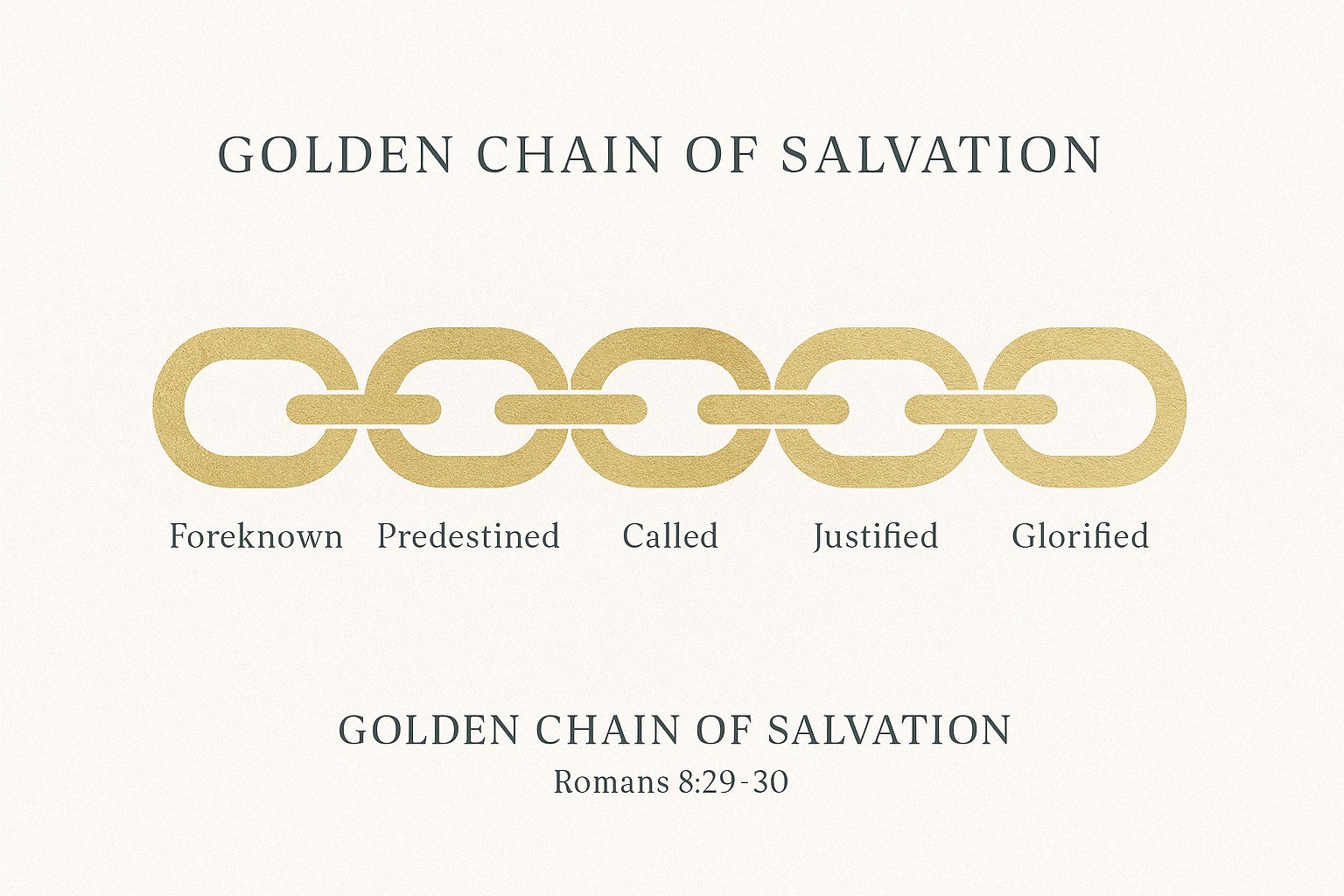
The sequence Paul lays out — foreknown, predestined, called, justified, glorified — is often called the “golden chain” of salvation. Think of it as God’s unbreakable storyline for His people. Every link is forged by Him, hammered strong by His will, and none of them snap under the weight of our weakness.
What makes this chain so striking is the way Paul writes it. Each of these verbs — proegnō (foreknew), proōrisen (predestined), ekalesen (called), edikaiōsen (justified), edoxasen (glorified) — are all in the aorist tense (a Greek verb form that presents actions as complete, as if they’ve already happened). Paul isn’t describing ongoing hopes or uncertain processes, but completed realities. From God’s perspective, the whole sequence is already finished.
Notice how Paul writes: the same group that is foreknown is predestined, called, justified, and glorified. He doesn’t say “most” or “some.” He says whom… these. That’s deliberate. Every link belongs to the same group. If one link could break, the whole chapter’s argument for assurance would collapse. But instead, Paul ends with a shout:
“Nothing can separate us from the love of God in Christ Jesus our Lord.”
(Romans 8:39)
That matters because it shows how secure this plan really is. There’s no gap between the links. No believer is foreknown and predestined but then left uncalled. No one is called and justified but not glorified. Everyone He starts with… He finishes with.
And that truth is meant to steady us when doubts creep in. When life feels fragile, when sin makes us question if we’ve blown it for good, Romans 8 reminds us: you are not holding on by a flimsy thread. You are held by a God who forges chains. His plan isn’t just resilient — it’s indestructible.
And that’s why Paul’s words about foreknowledge and predestination aren’t just theological terms — they’re anchors for the soul.
A Note on Understanding
Having seen the strength of the whole chain, it’s worth looking closely at the very first link — “foreknew.” How we understand this word shapes how we see the rest. Paul isn’t describing a passive glance down the corridors of time. The Greek word proginoskō can sometimes mean foresight, but in Scripture it most often carries the weight of relational knowing — God setting His love on someone beforehand.
We’ve already seen this in Amos 3:2 and Jeremiah 1:5 — where “knowing” meant chosen, covenant love, not just awareness. To reduce know to see empties the word of its covenantal depth.
Now bring that into Romans 8. If “foreknew” here simply meant foresight of our future faith, it would break the logic of Paul’s golden chain. Every other verb — predestined, called, justified, glorified — describes something God does, not something He observes. To insert “God watched ahead of time” at the front end shifts the focus away from His sovereignty and onto human initiative.
And notice the flow: Paul says “for whom He foreknew,” not “for what He foresaw.” The object isn’t our future decisions; it’s us. God’s people themselves are the ones foreknown — loved, chosen, set apart in advance. This distinction is crucial if we want to grasp Paul’s meaning and avoid flattening foreknew into a sense that doesn’t fit the context.
That’s why conditional election (foreknowledge = foresight) doesn’t fit. It reduces God from the Author of salvation to a spectator of it. It makes His choice dependent on ours — undercutting God’s sovereignty.
But Paul’s whole point is the opposite: salvation begins with God’s eternal purpose, not our eventual decision. And because each verb in this golden chain is written as a completed action, Paul can drive this section home with a shout of confidence:
“What then shall we say to these things? If God is for us, who can be against us?”
(Romans 8:31, NKJV)
Your story isn’t dangling on what you might one day do. It’s anchored in what God has already set in motion — and from His perspective, it’s as good as done.
Let’s Reflect:
- How does understanding proginoskō as deep, preexisting love shift how you read Romans 8:29?
- Why does this unbreakable chain — foreknown, predestined, called, justified, glorified — give confidence in God’s promises?
- When doubts creep in or life feels shaky, how does Romans 8:31 (“If God is for us, who can be against us?”) steady your faith?
Romans 8 lays out the golden chain — the unbreakable framework of God’s saving plan. If you’d like to trace some echoes of foreknowledge across the rest of Scripture, you can read the companion reflection –> Echoes of Foreknowledge.
Looking Ahead:
Next week in John 6, we’ll hear Jesus Himself speak about the ones the Father has given Him — and why not a single one will be lost. If Romans 8 shows us the love that planned it all, John 6 shows us the Savior who makes sure it’s finished.
Want to follow the thread from start to finish?
See the full series in the Table of Contents


Leave a Reply