
Last week, we saw how sanctification is God’s ongoing work of shaping us to be more like Jesus in our thoughts, actions, and desires.
Missed it? Read Part 9 → Sanctification: Growing to Be Like Jesus
At the end of this post, you’ll also find bonus resources (Appendices A–C) — tools to help you dig deeper into the entire series if you’d like.
Now, we’ve arrived at the final chapter of this journey. From the very beginning, we’ve traced the thread of salvation — God choosing, calling, justifying, and sanctifying His people. But here’s the question that ties it all together: if God starts the work, will He finish it?
This is where the story lands: perseverance and eternal security. The answer is a resounding yes — because the same God who called our name will never let us go. Settle in — this is one of the most important truths to unpack, and we’re going all in!
When God saves you — He keeps you.
That’s the promise woven all throughout Scripture. We’re not holding on to Him with white knuckles — He’s holding on to us.
“My sheep hear My voice… and they shall never perish (ou mē); neither shall anyone snatch them out of My hand.”
(John 10:27–28, NKJV)
The Greek phrase ou mē is definitive. It means “absolutely not,” no exceptions, no conditions. If we belong to Jesus, we’re safe in His grip now and forever.
Paul echoes this security:
“Whom He justified, these He also glorified.”
(Romans 8:30, NKJV)
There’s no break in that chain. If God starts the work, He finishes it.
Before we look at the warning passages, here’s something important: the Bible’s warnings aren’t cracks in God’s promises. They’re guardrails — meant to keep us awake, expose false faith, and remind us that true believers endure because God keeps them.
Warnings That Guide Us
But what about the warning passages — like Hebrews 6 or Galatians 5? Do they mean we can lose our salvation?
Not quite. Let’s look closer.
In the AD 60s, Jewish believers were under intense pressure to return to temple sacrifices, turning away from faith in Christ alone. That’s the backdrop of Hebrews 6, where the author gives a sobering warning:
“It is impossible… if they fall away (parapesontas), to renew them again to repentance…”
(Hebrews 6:4–6, NKJV)
At first, it does sound alarming. But just a few lines later he adds:
“We are confident of better things concerning you, yes, things that accompany salvation.”
(Hebrews 6:9, NKJV)
Simply put, these warnings aren’t written to shake the truly saved — but to sober the superficial. They’re meant to expose those who appeared to believe but never truly surrendered. We’ll dig deeper into the Greek word parapesontas (‘fall away’) later to see why it doesn’t contradict God’s keeping power.
But before we do, Paul gives us another perspective on endurance — one that shows what perseverance really looks like in action.
Running the Race — Not Losing the Prize
Paul used athletic language when he wrote,
“I discipline my body and bring it into subjection, lest, when I have preached to others, I myself should become disqualified (adokimos).”
(1 Corinthians 9:27, NKJV)
At first, that might sound like he feared losing salvation. But the Greek word adokimos means “unfit” or “disapproved,” not “unsaved.” Paul’s concern wasn’t falling out of grace—it was finishing well and not losing the reward of faithful service. He’s talking about usefulness, not justification. The point? Salvation is a gift secured by Christ; reward is a crown earned by endurance:
“If anyone’s work which he has built on it endures, he will receive a reward.
If anyone’s work is burned, he will suffer loss; but he himself will be saved, yet so as through fire.”
(1 Corinthians 3:14–15, NKJV)
Paul’s imagery reminds us that perseverance doesn’t keep salvation—it confirms it. Endurance proves that faith is real. The same reality shows up in John’s day—some who appeared to run the race eventually revealed they were never part of it.
“They went out from us, but they were not of us.”
(1 John 2:19, NKJV)
So when someone walks away, it doesn’t undo salvation — it reveals the absence of true faith. We’ll circle back to this later when we talk about abiding in Christ.
Paul also gives this caution in Galatians 5:4:
“You have become estranged from Christ… you have fallen from grace.” (NKJV)
So Paul’s warning isn’t about believers undoing salvation — it’s about people who trade grace for law, having never stepped inside the benefits Christ already secured. We’ll dig into this more fully later when we return to Galatians 5:4.
A Note on Understanding
The ou mē in John 10:28 and the unbroken chain of Romans 8:30 point to one solid truth: Eternal security is real. If God saved us, He will keep us — that’s a promise we can rest on.
Yes, Hebrews 6:4–6 carries weight. The language is heavy for a reason — it’s a sober warning against walking away from the truth we’ve heard. But it is not a contradiction to God’s keeping power.
The Greek word parapesontas (“fall away”) paints the picture of a decisive break — a willful turning from the truth after fully seeing it (but not yet believing). It’s not a stumble in weakness or a season of doubt. It’s the difference between tripping on the path and deliberately turning around to walk the other way. In other words, it’s a rejection before true belief — not someone truly saved, then lost.
But even here, Scripture gives us reassurance. This is why John reminds us again:
“They went out from us, but they were not of us.”
(1 John 2:19, NKJV)
The reality is clear: true believers endure. Not because we’re strong enough to cling to Christ, but because He is strong enough to hold on to us.
Trusting God’s Wisdom in Tough Questions
If you’ve been tracking with us through this series, you know election and predestination aren’t just theological words — they raise deeply personal questions:
“Why doesn’t God choose everyone?”
“How do I know if I’m chosen?”
The Bible doesn’t answer every “why.” But it does show us something even more important: the heart of the One making the choice.
“God demonstrates His own love toward us, in that while we were still sinners, Christ died for us.”
(Romans 5:8, NKJV)
That’s who our God is. He loved us at our worst — not because we sought Him, but because He sought us, even while we were running the other way.
And when we wrestle with what we don’t understand, Paul reminds us:
“How unsearchable are His judgments and His ways past finding out!”
(Romans 11:33, NKJV)
We’re not meant to have it all figured out. But we are meant to trust Him.
He isn’t cold or careless. His justice is perfect. His mercy is real. He calls all people to repent:
“God… now commands all men everywhere to repent.”
(Acts 17:30, NKJV)
And Jesus makes this stunning promise:
“All that the Father gives Me will come to Me, and the one who comes to Me I will by no means cast out.”
(John 6:37, NKJV)
In other words: if we are coming to Him, it’s because He’s already drawing us.
“No one can come to Me unless the Father… draws him.”
(John 6:44, NKJV)
So instead of trying to untangle every mystery, here’s what we can cling to:
God invites.
God saves.
God keeps.
That’s solid ground we can stand on.
Promises You Can Count On
When God saves us, He doesn’t leave us dangling, wondering if we’ll make it to the end. His Word is packed with bold promises that nail down our security:
“They shall never perish, neither shall anyone snatch them out of My hand.”
(John 10:28, NKJV)
That’s not a maybe — that’s a guarantee. We are safe in His grip.
“Whom He justified, these He also glorified.”
(Romans 8:30, NKJV)
The chain doesn’t break. If God starts the work, He finishes it.
“Nothing shall be able to separate us from the love of God.”
(Romans 8:38–39, NKJV)
Not our sin. Not our doubts. Not even death.
“You were sealed with the Holy Spirit of promise… the guarantee of our inheritance.”
(Ephesians 1:13–14, NKJV)
The Spirit Himself seals us as God’s own — a down payment guaranteeing the future He promised.
“He who has begun a good work in you will complete it.”
(Philippians 1:6, NKJV)
God doesn’t start what He won’t finish. Every promise He makes is a promise He keeps.
Names Written in Permanent Ink
Jesus made this promise to the believers in Sardis:
“He who overcomes shall be clothed in white garments, and I will not blot out his name from the Book of Life.” (Revelation 3:5, NKJV)
At first, it sounds conditional—if you overcome, then you stay written in. That’s why some interpret “overcoming” as remaining faithful until death, as if eternal life depends on continual performance. But Scripture defines “overcomers” differently: not as those who never stumble, but as those who truly believe in Christ:
“Whoever believes that Jesus is the Son of God overcomes the world.” (1 John 5:5, NKJV)
Faith itself is the victory. The Greek ou mē exaleipsō (“I will never, ever blot out”) isn’t a threat; it’s assurance. In Greek grammar, ou mē is a double negative of impossibility — the strongest way to say something cannot happen. Since true saving faith is overcoming—not simply remaining faithful until death—Jesus’ words aren’t a condition to meet but a certainty to rest in. His promise doesn’t warn the faithful; it reassures them that their victory is already secure in Him.
Christ’s promise stands unbroken: the one He saves, He keeps. Our names aren’t penciled in—they’re engraved by grace.
Clearing Up Confusing Verses
Let’s walk through these passages more carefully. Each one has its own context, its own Greek wording, and its own story to tell. And when we slow down to see that, we find they don’t undo eternal security — they actually confirm it.
“You have become estranged (katērgēthēte) from Christ… you have fallen from grace.”
(Galatians 5:4, NKJV)
At first glance, it sounds like Paul is saying believers can lose salvation. But the context tells a different story. Just two verses earlier, Paul warned that if the Galatians accepted circumcision as necessary for righteousness, “Christ will profit you nothing” (Galatians 5:2–3).
The Greek word katērgēthēte means “to be cut off from the benefit.” Paul isn’t saying salvation can be undone — he’s saying that if we try to be justified by law, we place ourselves outside the benefits Christ already secured.
Think of it like this: Christ is the umbrella of grace. It fully covers those who trust Him. But when someone chooses law instead of grace, they’re the ones refusing to step under it. The umbrella is still there, wide open, but they never actually come under its protection.
So Paul’s warning is not about losing salvation already possessed — it’s about never receiving salvation because they sought it the wrong way.
That’s why Paul insists:
“Therefore, having been justified by faith, we have peace with God through our Lord Jesus Christ.”
(Romans 5:1, NKJV)
With that foundation in place, let’s look at one of the strongest warnings in Hebrews 6:
“For it is impossible for those who were once enlightened, and have tasted the heavenly gift, and have become partakers of the Holy Spirit, and have tasted the good word of God and the powers of the age to come, if they fall away (parapesontas), to renew them again to repentance…”
(Hebrews 6:4–6, NKJV)
This warning feels heavy — and it should. But notice what kind of people the writer describes. They were enlightened (heard the truth), they tasted the heavenly gift (sampled Christ’s blessings), they shared in the Spirit’s work (saw conviction, miracles, fellowship), they tasted the Word and the powers of the age to come — and yet, they fell away.
These are strong experiences, but they are not the same as saving faith. The writer never uses the New Testament’s normal words for belief (pisteuō) or for being declared righteous (dikaioō). Instead, he paints the picture of exposure without surrender, participation without regeneration. That’s why he will go on to say in verse 9 that there are “better things… that accompany salvation.” The warning is chilling — but it’s not describing people who were born again. It’s describing people who got close but never crossed the line into saving faith.
And if we need an example, Judas is the living illustration. He walked with Jesus every day. He heard every sermon. He ate the multiplied loaves. He went out with the other disciples preaching and casting out demons (Matthew 10:1–8). He saw resurrection power with his own eyes.
In every way, Judas tasted — but he never swallowed. He looked like a disciple, but Jesus Himself knew from the beginning who did not believe, and said:
“There are some of you who do not believe.”
(John 6:64, NKJV)
And again:
“None of them is lost except the son of perdition.”
(John 17:12, NKJV)
Judas fell away, not because he lost salvation, but because he never truly had it.
That’s the sobering edge of Hebrews 6. People can sit under preaching, witness miracles, join in ministry, and still remain unconverted. The warning is deadly real — but it doesn’t overturn eternal security.
Clarifying “Tasted” in Hebrews 6
“But we see Jesus, who was made a little lower than the angels, for the suffering of death crowned with glory and honor, that He, by the grace of God, might taste (geuomai) death for everyone.”
(Hebrews 2:9, NKJV)
Some point to Hebrews 2:9 and argue, “Jesus didn’t just taste death — He fully died. So when Hebrews 6 says they tasted the heavenly gift, it must mean they fully experienced salvation.”
But that misses the context. The Greek word geuomai simply means “to experience.” The depth of that experience depends on what’s being described.
- In Hebrews 2:9, the context is atonement — Jesus “tasted death” completely, bearing the full penalty of sin as our substitute.
- In Hebrews 6, the context is exposure, not substitution. These people tasted the realities of salvation without ever receiving them. They sampled — but never swallowed.
The writer immediately gives an illustration to explain what he means:
“For the earth which drinks in the rain that often comes upon it, and bears herbs useful for those by whom it is cultivated, receives blessing from God; but if it bears thorns and briers, it is rejected and near to being cursed, whose end is to be burned.”
(Hebrews 6:7–8, NKJV)
The agricultural picture in verses 7–8 makes it clear:
- The rain represents God’s revelation and grace.
- The fruitful land pictures hearts that receive the Word and bear fruit — true believers.
- The thorny land pictures hearts that receive the same rain but stay barren — false professors.
Both soils feel the rain, but only one absorbs it. In the same way, those described in Hebrews 6 were surrounded by truth and blessing, yet never brought forth fruit.
Christ’s tasting of death was complete and saving. Theirs was temporary and surface-level — standing in the downpour but never drinking.
And that’s exactly why the author quickly reassures his readers — he’s not describing the saved, but warning those who’ve been exposed to truth without embracing it.
That’s why he immediately adds in verse 9:
“But, beloved, we are confident of better things concerning you, yes, things that accompany salvation…”
(Hebrews 6:9, NKJV)
In other words, what Judas showed was not salvation lost, but salvation never possessed. And that’s the point — Hebrews 6 isn’t written to leave believers doubting, but to drive us closer to Christ, the One who holds us secure.
Judas is proximity without possession — he walked with Jesus but never belonged. Another example comes later in Scripture with Demas, one of Paul’s ministry companions. Like Judas, Demas looked devoted for a time, but his departure revealed where his heart truly was.
Paul confirms this in 2 Timothy 4:10 — once a trusted co-laborer, but eventually he “deserted me, having loved this present world.” Demas is participation without perseverance — he joined in ministry for a season, but his love for the world won out.
Together, Judas and Demas remind us that proximity to truth and even participation in ministry are not the same as genuine salvation.
Jesus Himself gave the same sobering warning:
“Not everyone who says to Me, ‘Lord, Lord,’ shall enter the kingdom of heaven, but he who does the will of My Father in heaven. Many will say to Me in that day, ‘Lord, Lord, have we not prophesied in Your name, cast out demons in Your name, and done many wonders in Your name?’ And then I will declare to them, ‘I never knew you; depart from Me, you who practice lawlessness!’”
(Matthew 7:21–23, NKJV)
Notice — He doesn’t say, “I knew you once, but not anymore.” He says, “I never knew you.” Outward works, even ministry and miracles, cannot replace true saving faith.
Jesus gives a different but related warning in John 15:
“If anyone does not abide (meinā) in Me, he is cast out as a branch…”
(John 15:6, NKJV)
Here Jesus is teaching about true and false disciples. The Greek word meinā means “remain.” Some branches appear attached but never draw life from the vine.
Judas is again the clearest example — outwardly connected, but never truly abiding. And John later confirms the pattern:
“They went out from us, but they were not of us.”
(1 John 2:19, NKJV)
Abiding isn’t a condition we maintain to stay saved; it’s the proof we’ve been saved in the first place.
Clarifying “Abide in Me”
Some read Jesus’ words about abiding (meinō) as a condition we have to keep in order to stay saved. But the flow of John 15 shows the opposite. Abiding doesn’t maintain salvation — it proves it.
A living branch naturally remains connected to the vine because life is flowing through it. A branch that dries up was never drawing life to begin with. Abiding proves life; it doesn’t produce it. True faith endures because its source is Christ, not us.
And that brings us to another passage often misunderstood in the same way — one that sounds severe on the surface but actually reinforces security when read in context.
“For if we sin willfully after we have received the knowledge of the truth, there no longer remains a sacrifice for sins…”
(Hebrews 10:26, NKJV)
Again, the backdrop matters. Some in the AD 60s were considering going back to temple rituals instead of trusting Christ’s once-for-all sacrifice.
The author warns: if you reject Christ, there’s no backup plan — “there no longer remains a sacrifice for sins” (v. 26). But this doesn’t contradict eternal security. Just a few verses earlier he had said:
“For by one offering He has perfected forever those who are being sanctified.”
(Hebrews 10:14, NKJV)
True believers are perfected forever. Notice the contrast in the wording: “has perfected” is past tense — a once-for-all act already accomplished in Christ. “Are being sanctified” is present tense — God’s ongoing work in us right now. Together, they show the double security of salvation: it’s already finished, and it’s still being carried forward by Him. The warning is directed at those tempted to hear the gospel and still walk away, not at those whom Christ has already secured.
“If… they are again entangled… the latter end is worse for them than the beginning.”
(2 Peter 2:20, NKJV)
Peter isn’t describing Christians losing salvation. The entire chapter is aimed at false teachers—people who had access to truth but never experienced transformation. Earlier, he calls them “false prophets” (v. 1), “wells without water” (v. 17), and “slaves of corruption” (v. 19)—terms that could never describe believers indwelt by the Spirit.
They had knowledge about Christ but not union with Him. Their outward reform didn’t change their inward nature, and when they returned to sin, it exposed who they’d been all along.
His imagery makes it plain:
“A dog returns to his own vomit… and a sow, having washed, to her wallowing in the mire.”
(2 Peter 2:22, NKJV)
Outward reform can’t create new life. Their return to sin showed that the gospel had touched their behavior but never transformed their hearts.
Key Point:
Each of these passages, read in context, is a warning about false faith, not the undoing of salvation. And here’s the paradox: if these passages stir our heart and push us to hold tighter to Christ, that itself is evidence we belong to Him. The warnings don’t weaken assurance; they strengthen it. The warnings are real — but so is the security. They don’t cancel out Jesus’ promise that His sheep will never perish.
And that’s why this matters so much. If we read the warnings as proof salvation can be lost, we end up twisting God’s promises into conditions He never gave. Which brings us to an important reality:
When Promises Get Rewritten
Some Christians (especially in Arminian traditions) interpret these warnings as proof that salvation can be lost. But notice what that interpretation requires: it adds conditions God Himself never stated.
Why? Because the driving concern is preserving human free will. But free will isn’t the problem — human nature is. The will always follows the heart, and Scripture says the natural heart is enslaved to sin (Romans 6:17; John 8:34). In trying to defend freedom, Arminianism overlooks that apart from regeneration, the human will operates under the pull of its fallen nature — never neutral, never seeking God on its own.
So in elevating free will, they elevate it to a level the Bible never goes. Scripture does affirm responsibility — we’re called to believe, to repent, to abide. But responsibility doesn’t equal ability. True freedom of the will only comes when it’s freed from the bondage of a fallen heart — and that happens only by God’s regenerating grace. God’s grace doesn’t violate the will; it liberates it. The assumption is that if God secures salvation from start to finish, then our freedom must be violated. But the Bible never frames it that way. Our will is never made out to be the final safeguard of salvation — that role belongs to God alone. In trying to protect a certain view of free will, Arminianism ends up weakening the very promises meant to anchor our assurance.
Jesus said, “They shall never perish” (John 10:28). The Greek ou mē means “absolutely not,” no exceptions.
Arminianism adds: “unless they walk away.”
Paul said, “Nothing shall be able to separate us from the love of God” (Romans 8:39). Arminianism adds: “except you.”
Paul wrote, “You were sealed with the Holy Spirit of promise… the guarantee of our inheritance” (Ephesians 1:13–14).
Arminianism adds: “unless you break the seal.”
The writer of Hebrews declared, “By one offering He has perfected forever those who are being sanctified” (Hebrews 10:14).
Arminianism adds: “perfected — but only until you fall away.”
None of those conditions appear in the text. They’re assumptions read into the promises — additions that weaken the very words God gave to secure our assurance.
The problem isn’t just the conditions Arminianism adds — it’s that those additions don’t harmonize with the rest of Scripture. God’s Word never contradicts itself. The promise passages are unmistakably clear: eternal life is secure, sealed, and kept by God. The warning passages are more complex, but the clear passages are meant to clarify the difficult ones — not the other way around. If the plain promises of God have to be rewritten to make the warnings fit, something’s wrong with the interpretation, not with the text. True interpretation brings harmony, not tension. When we let the clear shape the unclear, the entire picture comes into focus: God’s warnings don’t cancel His promises — they confirm them.
Counter-Argument: Does Eternal Security Encourage Sin?
A common pushback goes like this: “If salvation can’t be lost, what’s stopping someone from sinning freely?”
But eternal security doesn’t erase responsibility — it transforms motivation.
We don’t obey to keep salvation; we obey because we have salvation. The same grace that secures us also reshapes us.
“The grace of God… teaches us that, denying ungodliness and worldly lusts, we should live soberly, righteously, and godly.”
(Titus 2:11–12, NKJV)
If someone uses grace as permission to sin, it shows they never understood grace at all (Romans 6:1–2). True believers may stumble, but they can’t live in ongoing rebellion without conviction or correction. God disciplines every child He loves:
“For whom the Lord loves He chastens,
And scourges every son whom He receives.”
(Hebrews 12:6, NKJV)
Eternal security isn’t a loophole — it’s the safety net that makes holiness possible. We live faithfully not to stay saved, but because we are secure in Him.
Let’s Reflect
- How does John 10:27–28 give you confidence that your salvation is secure?
- Why do you think Scripture includes warnings like Hebrews 6:4–6, and how can they help us stay faithful?
- How does trusting God’s wisdom help you rest, even when His choices are hard to grasp?
- Why does Romans 5:8 give you confidence in God’s love, even when you’re unsure about yourself?
- How do Hebrews 10:26–29 and 2 Peter 2:20–22 challenge or affirm your view of eternal security?
- Looking back on the whole journey from election to eternal security, which truth has anchored your faith the most?
- Who in your life needs to hear that the God who saves also keeps?
Series Wrap-Up: God’s Sovereign Plan from Start to Finish
These truths are worth holding on to — and the best part is, they’ll hold on to us:
- Let the Bible Lead – Dig in for yourself and stay rooted in Scripture (Acts 17:11)
- Praise God’s Love – He saved us when we least deserved it (Romans 5:8)
- Trust His Promises – He will finish what He started (Philippians 1:6)
- Live with Courage – Speak the truth in love (Ephesians 4:15)
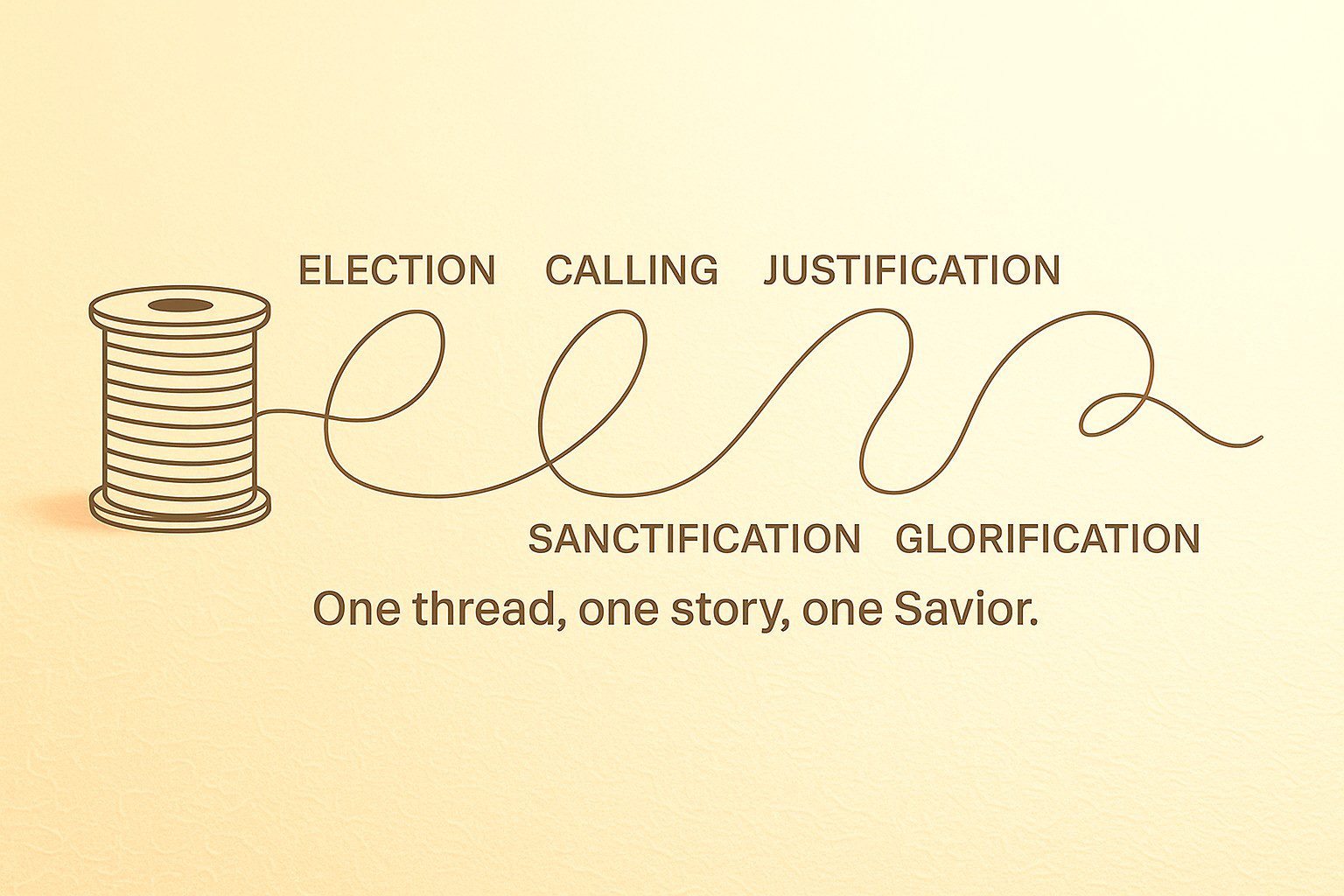
From election to eternal security, we’ve been following the same thread — God’s unshakable, start-to-finish plan to save and keep His people. This isn’t a random collection of Bible truths; it’s one seamless story. Before time began, God chose His own. In time, He called them. He justified them through the finished work of Christ. And one day, He will glorify them forever.
We’ve wrestled through big questions — what predestination really means, how faith fits in, why Scripture gives such strong warnings, and how perseverance is even possible. We’ve slowed down in key passages, looked at the Greek where it matters, and paid attention to the context so we could hear exactly what God is saying — and why He says it the way He does.
If you remember one thing from all ten parts, let it be this: Salvation is God’s work from first spark to final glory. Our hope doesn’t rest on how tightly we can hang on to Him. It rests on how securely He’s holding us.
As we look back, here are a few threads worth holding close:
- God’s choice is rooted in His love, not our worth.
- His call doesn’t just invite — it accomplishes.
- Justification is once for all; sanctification is a lifelong, Spirit-powered journey.
- Perseverance isn’t about our grip on Him, but His grip on us.
The golden chain never had a missing link. From election to glory, every promise was forged by His hand — and not one has ever failed.
“Now to Him who is able to keep you from stumbling,
And to present you faultless
Before the presence of His glory with exceeding joy…”
(Jude 24, NKJV)
So let’s share the gospel boldly, knowing the outcome is in God’s hands, not ours. And when doubts creep in or questions remain unanswered, we can anchor our hearts in what’s clear: the Good Shepherd called our name, drew us near, and promised never to let us go. That’s not just theology — that’s hope we can carry into tomorrow.
Rest in the hands that chose you, redeemed you, and will one day welcome you home.
Bonus Resources — Appendices
This study doesn’t stop here. To help you dig deeper, I’ve put together three appendices:
- Appendix A: Key Bible Verses for Each Topic
- Appendix B: Detailed Bible Verse Explanations
- Appendix C: Comparing Views — Testing the Threads
Each one is designed to give you tools to study further, compare views honestly, and see how Scripture itself holds the clear thread together.
Want to follow the thread from start to finish?
See the full series in the Table of Contents




Leave a Reply