
Following the Thread of Redemption — Part 9
This post is part of the Following the Thread of Redemption series. You can find the full series guide and table of contents here.
If you missed Part 8 — Christ: Fulfillment, Not Interruption — we saw that Jesus stands at the center of the entire biblical storyline.
The Seed has come.
The Lamb has arrived.
The faithful Son has walked where Adam and Israel failed.
Now the question is no longer who He is.
The question is: what did He accomplish?
The Lamb led to slaughter
When John the Baptist first saw Jesus, he did not call Him teacher or reformer. He said:
“Behold! The Lamb of God who takes away the sin of the world!” (John 1:29, NKJV)
That language is deliberate.
Passover echoes.
Sacrifice echoes.
Substitution echoes.
By the time we reach the crucifixion, the imagery is unmistakable. The Lamb stands silent before His accusers. He is condemned though innocent. He is lifted up.
The conflict promised in Genesis 3 reaches its climax.
The serpent strikes.
But this strike is not final.
The cross is not accidental
Jesus repeatedly spoke of His death as something appointed, not unforeseen.
In John 10, He says:
“I am the good shepherd. The good shepherd gives His life for the sheep.” (John 10:11, NKJV)
And again:
“No one takes it from Me, but I lay it down of Myself. I have power to lay it down, and I have power to take it again.” (John 10:18, NKJV)
The cross is not tragedy spiraling out of control. It is deliberate self-giving.
The Shepherd lays down His life.
For whom?
“For the sheep.”
The language is personal and purposeful.
Substitution accomplished
Isaiah 53 had promised:
“The Lord has laid on Him the iniquity of us all.” (Isaiah 53:6, NKJV)
At Calvary, that promise becomes reality.
Sin is not ignored.
Justice is not relaxed.
Wrath is not dismissed.
It is borne.
Paul later explains:
“For He made Him who knew no sin to be sin for us, that we might become the righteousness of God in Him.” (2 Corinthians 5:21, NKJV)
This is exchange.
Our sin laid upon Him.
His righteousness credited to us.
The law that exposed sin is satisfied.
The justice that demanded payment is fulfilled.
Not symbolically.
Actually.
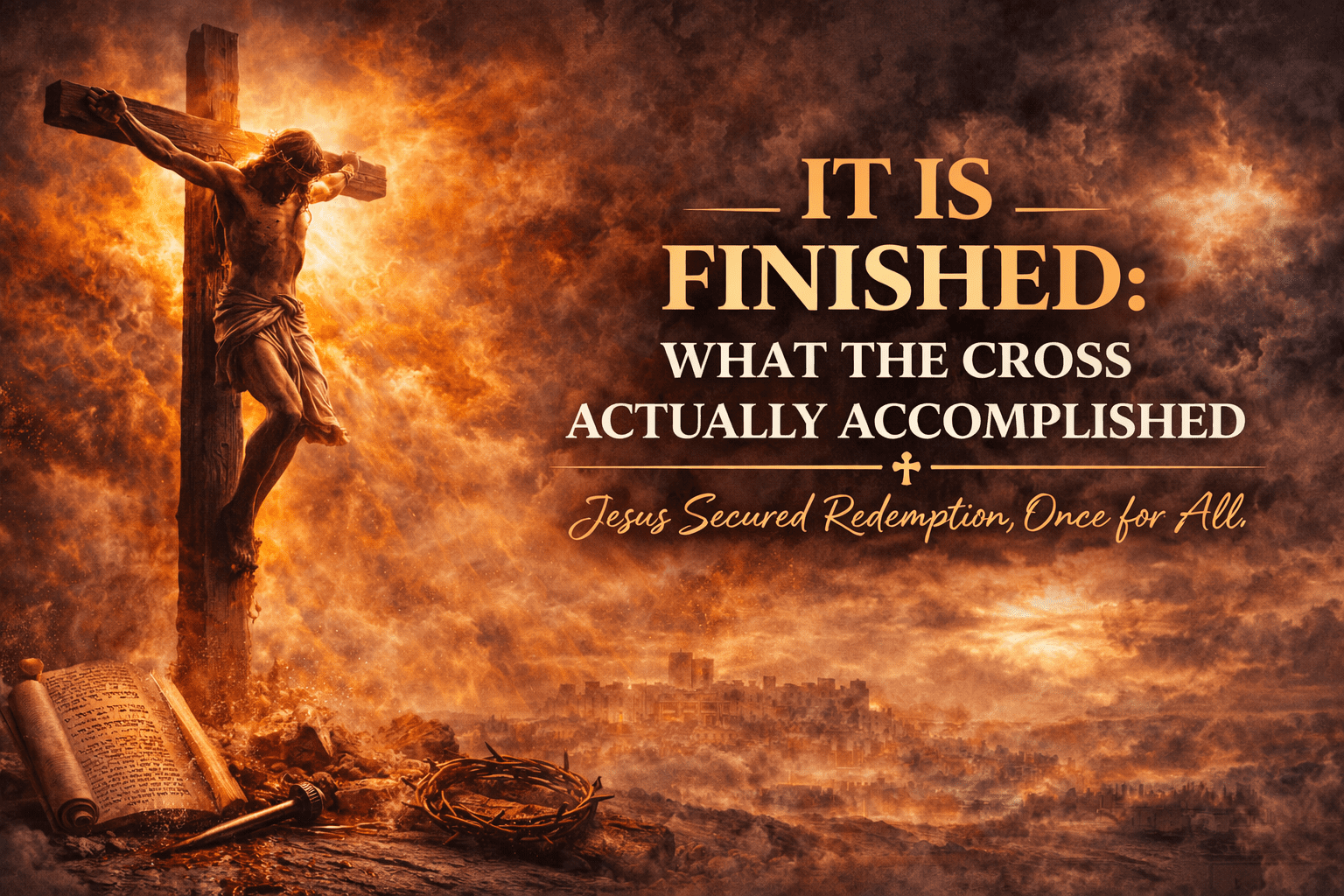
“It is finished.”
Then we come to the moment that anchors everything.
“So when Jesus had received the sour wine, He said, ‘It is finished!’ And bowing His head, He gave up His spirit.” (John 19:30, NKJV)
Finished.
Not begun.
Not made possible.
Not opened as an option.
Finished.
The Greek term carries the sense of something completed, fully accomplished, brought to its intended end.
The debt is paid.
The sacrifice is complete.
The work is done.
If Passover required repeated observance, if Sinai required continual sacrifices, the cross declares completion.
Once for all
The book of Hebrews makes this unmistakable.
“But this Man, after He had offered one sacrifice for sins forever, sat down at the right hand of God.” (Hebrews 10:12, NKJV)
Sat down.
Old covenant priests never sat in the tabernacle. Their work was never done. Sacrifice followed sacrifice.
But Christ offers one sacrifice — and then sits.
Why?
Because nothing remains to be added.
The thread that began with a lamb in Egypt now finds its fulfillment in a Lamb whose work does not need repetition.
What did He actually secure?
This is where we must be careful readers.
If Christ bore sin.
If He satisfied justice.
If He offered one sacrifice forever.
If He declared the work finished.
Then the cross is not merely potential.
It is effective.
He died to secure redemption.
Hebrews says:
“For by one offering He has perfected forever those who are being sanctified.” (Hebrews 10:14, NKJV)
Perfected.
Not temporarily improved.
Not provisionally adjusted.
Perfected — in standing before God.
The Shepherd lays down His life for the sheep. The sacrifice is offered for a people. The new covenant promised forgiveness and transformation — and the cross accomplishes the ground of both.
The serpent’s head
Genesis 3:15 promised a crushing.
The cross looks like defeat.
But resurrection proves otherwise.
Death could not hold Him. The wound to His heel becomes the blow to the serpent’s head. The enemy’s greatest weapon becomes the instrument of his defeat.
What looked like loss becomes victory.
The promised Seed has struck.
Why this matters for the thread
Creation began with God acting first.
Redemption in Exodus required blood.
The law exposed guilt.
The prophets promised a substitute and a new heart.
Now the substitute has come, and the sacrifice has been made.
The work that prepares the way for new birth is complete.
But one question remains.
If the cross secured redemption, how does that finished work become ours personally?
How does what Christ accomplished get applied?
That is where the story now turns.
Coming next
Part 10 — From Death to Life: How God Applies What Christ Accomplished
We’ll trace calling, drawing, and new birth — and see how the finished work of Christ moves from history into the heart.
Until then, sit with John 19 and Hebrews 10. Notice the finality. Notice the rest. Notice the Shepherd who laid down His life.
The thread has reached the cross.
Now we watch how that finished work is applied.

Leave a Reply